
Ephrata schools get funds for violence prevention, CTE support
School board awards design bid for EHS roof replacement


EPHRATA — The Ephrata School District has received a $30,000 grant as part of a state initiative to develop community-based approaches to prevent youth violence and support students affected by gang activity and group-related conflict.
“This funding provides an important opportunity to strengthen systems that help students feel safe, connected and supported,” district superintendent Ken Murray said in a press release. “By partnering with families, community organizations and local agencies, we can proactively address challenges and build a stronger safety net around our students.”
Ephrata is one of just five school districts selected statewide to participate in the development initiative. Awarded by the Washington Office of Superintendent of Public Instruction, Ephrata was nominated for the grant by Hunter McLeod, threat assessment coordinator for the North Central Educational Service District.
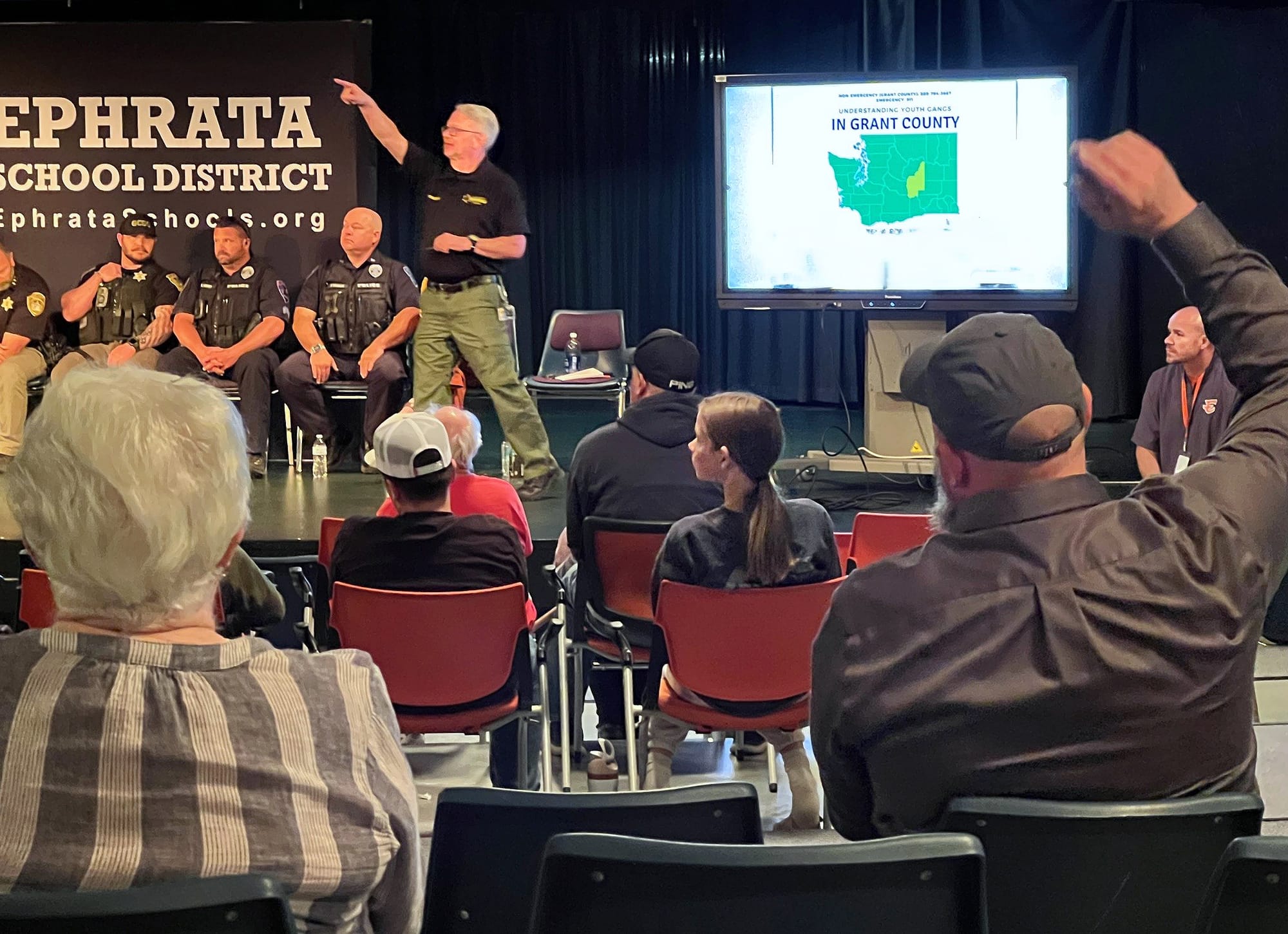
McLeod’s support came after Ephrata schools held a training event with leadership last year, followed by a community town hall on understanding youth gangs, said district communications director Sarah Morford.
“The grant dollars are intended to further efforts started last year, focusing on prevention, connection and partnerships with local agencies,” she said.
The OSPI grant emphasizes:
— Violence prevention and intervention strategies;
— Collaborating with law enforcement, juvenile courts, and community-based organizations;
— Implementing structured ways to assess and address potential threats;
— Increasing access to mentoring and behavioral health services;
— Creating systems that continue beyond the term of the grant.
The effort is not a response to a specific spike in violence, say school officials; rather, it’s considered a proactive investment in awareness and early intervention strategies.
“This work is about prevention, connection and partnership,” Murray said. “When students feel seen and supported by trusted adults, our schools become safer and more welcoming for everyone.”
The funds will be used to train staff and create “consistent systems” across Ephrata’s schools. The district also intends to host school leaders, counselors, law enforcement, mental health professionals, and community groups in a session to develop a shared plan for preventing gang violence and involvement.
Another town hall meeting will be held later this spring to share information with the public and gather feedback, the district said.
Along with Ephrata, similar grants were awarded to Evergreen Public Schools in Vancouver and the school districts of Bridgeport, Mukilteo, and Richland.
— — — —
Separately, Ephrata School Board members during their Feb. 23 meeting heard from Sarah Vasquez, the district’s career and technical education director, and high school CTE instructor Scott Sandberg regarding other recent grant awards totaling $230,000.
Vasquez said the funding includes $200,000 in a “Career Preparation and Launch” grant, part of $4 million in competitive grant allocations approved in 2025 by the state legislature.
“This is very exciting,” she told the board.
The monies can only be used for equipment purchases. Ephrata’s plans call for using $100,000 to update the high school greenhouse with new polycarbonate siding, heating and cooling systems, and grow lights; $60,000 for welding tables and booths; and $40,000 for engineering equipment in a new pre-engineering class taught by Sandberg in collaboration with EHS woodshop instructor Dale Hagy.
“We design it and they build it,” Sandberg said of the two teachers’ respective students.
In addition, said Vasquez, Ephrata has received a $30,000 Perkins Reserve Grant to support CTE activities and student organizations including Future Business Leaders of America, Future Health Science Professionals, FFA, Technology Student Association, Skills USA, and Family, Career, and Community Leaders of America.
— — — —
At last Monday’s meeting, school board members Casey Devine, Matthew Truscott, and Josh Sainsbury also:
— Accepted an apparent low bid of $77,700 by Design West Architects to develop construction drawings and specifications and administering building permit applications and contractor bidding for a complete redesign and replacement of the high school roof.
Other bidders and their fee amounts were ALSC Architects ($85,000) and Integrus ($85,500).
The 40-year-old school has previously been reroofed, but a warranty period is ending and structural flaws in the original design have contributed to recurring water leaks, said assistant superintendent and former EHS principal Aaron Cummings.
“We believe it’s time for a replacement,” he said.
Cummings said the district intends to start work this spring and be completed over the summer before classes resume in September.
Total cost is estimated upwards of $2.3 million. Murray said funding will be a combination of reserves, budgeted capital project dollars, and possibly some leftover capital levy monies. Murray hoped the district would not have to borrow any additional money for the project, which he called “big … but absolutely needed.”
— Heard a report from Sharon Scellick, the district’s co-director of teaching and learning, and EHS principal Ashlie Miller and vice principal Eddie Martinez regarding Ephrata’s “Open Doors” programs which seek to reengage older students ages 16-21 who may have dropped out of school or who are not on track to graduate by age 21.
Scellick said Ephrata will continue an association with Big Bend Community College in Moses Lake for some services, but the district also wants to expand local services including work with the local state-operated Sunrise Group Home. Transportation, case management, and individualized curriculum are issues which need to be addressed, said Scellick, noting, “We have a lot of work ahead of us.”
— Were informed that the district is proposing to end its assessment tracking and administrative processing services for certain student populations in an information system designated to OSPI as “Beezley Springs.”
The proposed system closure is not associated with the Beezley Springs building itself, which will continue to be utilized on the Ephrata High School campus.
Currently, the information system includes 32 students who are homeschooled or from private schools, some with disabilities or as English-language learners, who may be taking state assessment tests or undergoing evaluations administered through the district.
Ephrata has determined it would be more appropriate for those students to be tracked and receive services through a different structure, and has notified OSPI of that intention. The process requires a public hearing tentatively scheduled for the school board’s March 23 meeting, Murray said.
If the transition process is approved, the affected students would return to their homeschool “roster.” The district does not expect any negative financial, staffing, maintenance or transportation impacts, officials said.


