

Would-be gardeners, a simple message: 'Just plant something'
Isaac Lnenicka: “It is gratifying to participate in a cycle that is so beautifully efficient.”


BY SHARON C. HASTINGS
Contributing Writer
As the Columbia Basin welcomes warming soil and longer days, Isaac Lnenicka has a simple message for would-be gardeners harboring any “green thumb” doubts or hesitation:
Just plant something.
“Spring, summer and fall, there’s stuff you can plant — even as late as September,” said the Soap Lake horticulturist and owner of Liberty Gardens. “If you just start planting, you’ll definitely get a harvest this year.”
That encouragement will anchor Lnenicka’s opening address at the upcoming Grant-Adams Master Gardener Eco-Gardening Symposium, “From Seed to Table,” at Big Bend Community College, where about 180 gardeners are expected to gather later this month.
His talk will range from practical vegetable gardening to a deeper subject he’s passionate about: the life beneath our feet.
“I love talking about soil,” said Lnenicka, a 2003 graduate of Ephrata High School. “We don’t really treat soil like it’s living. We treat it like something to pulverize and add chemicals to. But good soil is full of life.”
That shift in perspective — seeing soil as a living system rather than an inert medium — can transform not only gardens, but families, he said.
Even small backyard plots can have an outsized impact, especially on children, said Lnenicka, who with his wife are raising a young daughter and son.
“When you’re growing your own food, your kids are much more interested in eating it,” he said. “If they pick it, they’re way more likely to eat it.”
He frames that connection in simple, tangible terms. “Their bodies are literally building new cells from whatever you give them,” he said. “If that’s processed food, that’s what they’re using. But if it’s fresh, healthy food from your garden, that’s what builds them.”
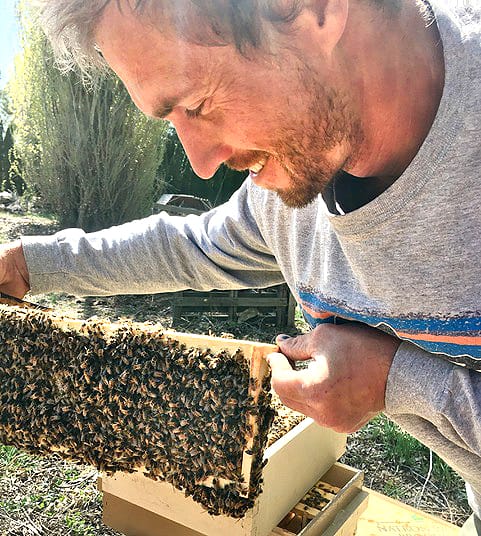
At home, that philosophy isn’t theoretical. Lnenicka says his family grows much of what they eat. Along with vegetables, they keep bees, raise eggs and their own meat.
“In addition to the garden, we produce all of our own eggs, most of our chicken, lamb and pork,” he said. “Conservatively, we’re probably growing 60% of our diet, which I feel really good about.”
It’s a system built on cycles. Winter squash that won’t keep instead gets fed to chickens. The chickens produce both eggs and compost fertilizer. The compost feeds the soil. That enriched soil feeds the next crop.
“It is gratifying,” said Lnenicka, “to participate in a cycle that is so beautifully efficient.”
For Basin gardeners ready to experiment, he suggests growing crops that rarely appear fresh in stores. Young ginger, for example, can thrive locally with protection. Winter spinach, Lnenicka contends, is a revelation.
“The flavor and sugars in winter spinach — it makes you like spinach,” he said with a laugh. “People who’ve never had good spinach don’t know what they’re missing.”
Underlying all of it is his belief that healthy soil is the key which unlocks the true potential of plants.
“Once you get the soil biology right, your plants are all of a sudden way healthier,” he said. “I think the potential for plants is far greater than what we’ve realized.”
That philosophy also shapes Liberty Gardens itself, where Lnenicka grows intensively on just a quarter acre with surplus produce sold both online and at the Moses Lake Farmers Market. Without the constraints of 'tractor spacing,' crops can be planted closer together, increasing yield while keeping the work at a human scale.
“The human scale is what I enjoy,” he said.
For those wondering whether a backyard garden can really make a difference, Lnenicka doesn’t hesitate.
“I think a true revolutionary act is growing your own food,” he said. “Just get after it.”
The WSU Master Gardeners Eco-Gardening Symposium runs from 7:45 a.m. to 1:30 p.m. on Saturday, April 18, at BBCC. Tickets are free and a few still remain, but registration is required.


