Utility upgrades, Rite-Aid redesign in $35.5M Ephrata budget
EPHRATA – Ephrata city council members last week approved a $35.57 million budget that will fund municipal operations in 2026.


EPHRATA – Ephrata city council members last week approved a $35.57 million budget that will fund municipal operations in 2026.
In part, the new budget contains allocations for several infrastructure projects which have been ongoing for several years but are now approaching completion. Those include multi-million-dollar upgrades to the city’s wastewater treatment plant and a new water reservoir and pressure zone improvements on the east side of town. Both are largely funded by state grants and low-interest loans.
In July, the council approved spending $2.31 million in local reserve monies to purchase the former Rite-Aid Pharmacy building in the 200 block of South Basin Street. Another $1.2 million in reserves is set aside in the new budget for redesigning and engineering the building for future use, said city finance director Kristen McDonnell.
“The former Rite Aid is in a central downtown location, making it ideal for city facilities,” officials said when the purchase was announced this summer. “Our current city hall – shared with the police department – has outgrown in space. Renovating our current building to meet our needs would cost more than purchasing this property.”
No specific decisions had been made at that time on how the acquired property will be utilized, the city said, noting, “We’re exploring all options.” Those include moving from the current city hall one block away on South Alder Street, perhaps including police operations, or other city functions.
Other capital outlays anticipated in the coming year include:
- Using a combination of local real-estate excise tax (REET) revenues, a grant from the Paul Lauzier Foundation, and possible state recreation grant monies to begin “hardscape improvements” for future pickleball and futsal courts adjacent to the city’s Splash Zone swimming pool.
- Chip-sealing for maintenance of about 3.5 miles of high-volume arterial streets using a combination of local transportation-improvement benefit district monies and a $614,000 state grant. The city is also seeking state grants that, if received, would fund sidewalk improvements and connections along Basin Street.
- Improvements and repairs to city water wells.
- Shopping for a sewer vacuum truck – a specialized vehicle which uses a powerful pump to clear blockages and clean lines in sewer, septic, and industrial systems.
The city will continue to maintain a staff of 55 fulltime regular employees, with the possibility of adding two police officers if a state grant is received through legislative passage of House Bill 2015, which provides resources to state and local criminal justice agencies.
Employees are scheduled to received a 3.4% cost-of-living pay increase, said McDonnell. She said health insurance costs have increased 7.2%, and the city’s overall insurance liability premiums went up 20% this year. Next year’s rate adjustment, if any, by its insurance pool provider is not yet known.
Correspondingly, the council recently increased most city fees by 3.4%, a standard annual procedure based on any adjustments in the federal Consumer Price Index – determined this year from the August CPI, prior to the federal government shutdown.
Ephrata also typically employs between 40 to 60 seasonal workers each year, primarily summer help at the Splash Zone pool.
No significant comments emerged during two public hearings conducted by the city council prior to the Dec. 3 adoption of the 2026 budget. Under state law, municipalities and counties in Washington must adopt a budget for the coming year by Dec. 31.
Mayor Bruce Reim and council members thanked city hall staff for their work in preparing the new budget. Overall, it contains about two dozen separate categories and funds, many of which are proprietary and only allow monies for designated purposes, such as utility accounts.
The largest at $8.1 million is the current expense fund, which pays for other core public services – such as police, fire, and other municipal functions – which don’t have a dedicated funding source. Other funds include water-sewer construction, also $8.1 million; water-sewer operations ($7.86 million), sanitation ($2.4 million), parks ($1.39 million), transportation benefit district ($1.26 million), equipment rental/city vehicles ($749,300), streets ($648,450), cemetery ($226,200), and library ($268,300).
Municipalities receive revenues through a combination of local property and sales taxes, utility payments, service and license fees, fines, loans, and grants.
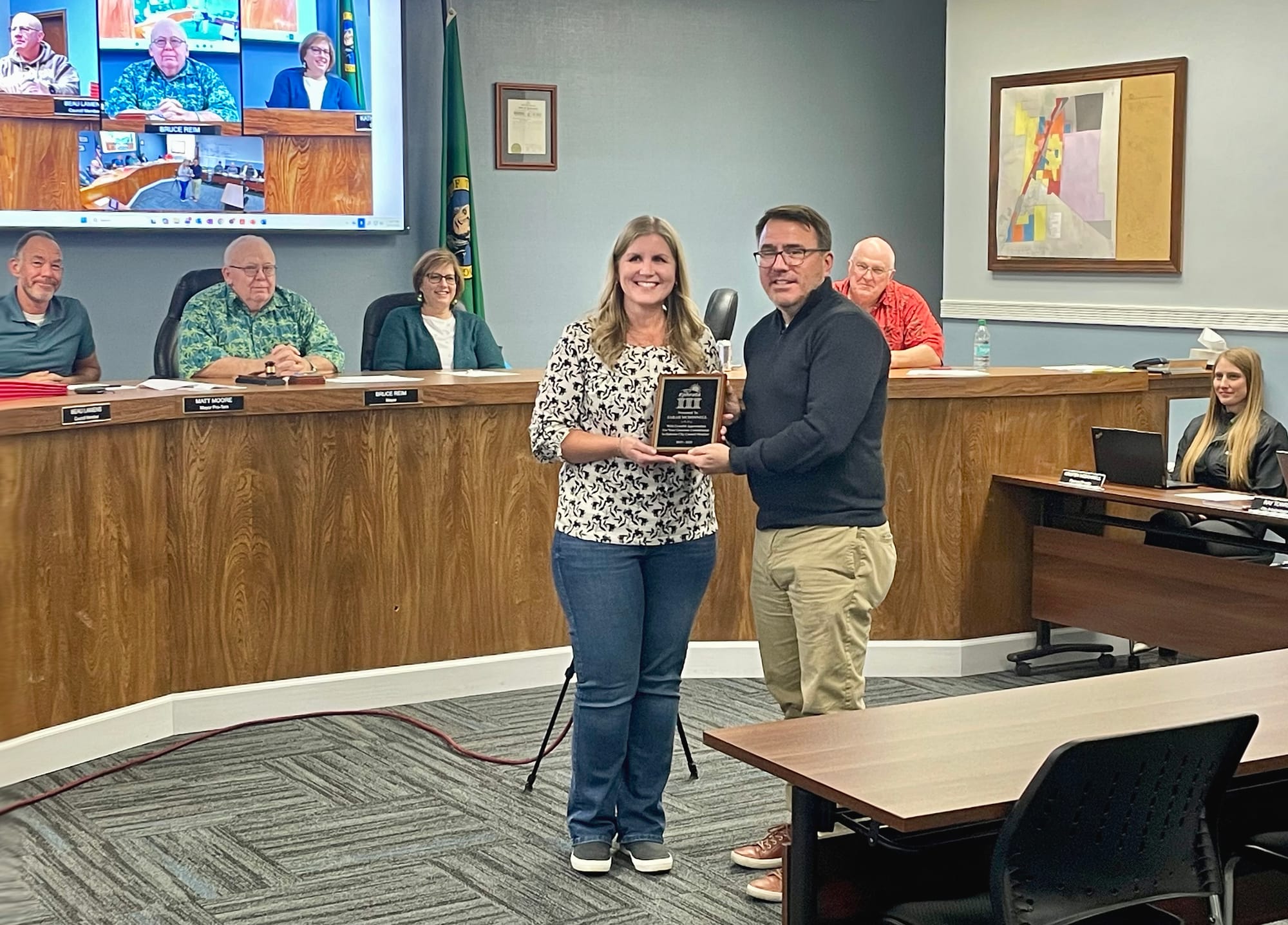
In other business during their Dec. 3 meeting, the council recognized the efforts and contributions of departing member Sarah McDonnell, who did not seek re-election to a new four-year term in office. City administrator Ray Towry presented McDonnell with a commemorative plaque in appreciation of her service. She was initially appointed to the council in December 2018. McDonnell will be succeeded in January by council newcomer James Mathis, who was unopposed for the Position 1 seat in the Nov. 4 general election.